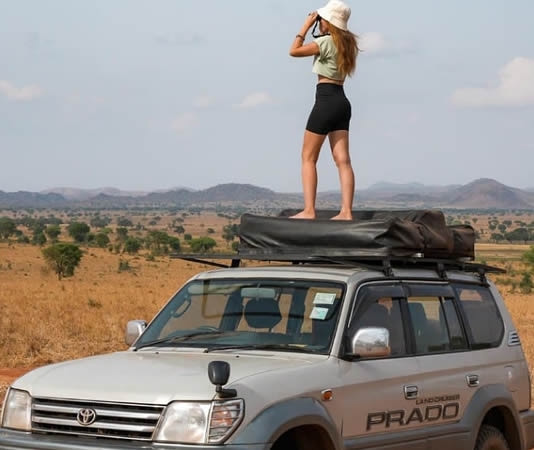
A 21-Day Self-Drive Safari Across Tanzania: Dar es Salaam to Arusha
This route is one of the great overland journeys on the continent, linking the wild, lightly-visited southern reserves with the iconic northern circuit in one continuous loop by 4×4. For travelers researching 4×4 safaris Tanzania, this itinerary is built entirely around self-drive travel, from vehicle pickup in Dar es Salaam to drop-off in Arusha.
Getting Ready
The vehicle: Look for a diesel-powered 4×4 built for the bush — something in the Land Cruiser 76/78/79 family or equivalent — fitted with a rooftop tent, extended fuel range, two spares, jerry cans, a cooler or fridge, and front protection. Several established car rental Tanzania operators offer one-way rentals in Tanzania between Dar and Arusha, typically for an extra $100–$300 in relocation fees. It’s worth comparing a few car rental Tanzania providers directly, since fleet availability and one-way rental terms vary. A properly kitted rig runs roughly $100–$180 a day.
Entry fees: Tanzania’s park authorities charge admission in US dollars, generally $40–$70 per person daily depending on the reserve, with campsite fees adding another $20–$40 a night. Visa cards work at most gate offices.
Diesel: Top off the tank in Dar and again at every fuel stop along the way — Morogoro, Iringa, Dodoma, Arusha, and Moshi all have reliable supply. Keep an extra 40 litres or more in cans for the remote stretches around Ruaha and the interior of Nyerere.
Timing: The dry months from June through October are best — tracks are solid, animals cluster around remaining water, and camping nights stay cool. Steer clear of the heavy rains between March and May unless your vehicle has a snorkel and you don’t mind getting stuck.
Days 1–2: Dar es Salaam to Mikumi National Park (about 300 km)
Collect your self-drive 4×4 in Dar and drive west on the paved A7 through Morogoro. You’ll reach Mikumi by mid-afternoon, where you can pitch camp at either the TANAPA public site inside the park or a private tented camp just outside it with bandas available. As the nearest major reserve to the capital, Mikumi makes an ideal first stop — the open Mkata floodplain is compact and easy to navigate, yet reliably turns up lions, elephants, buffalo, zebra, and giraffe. Plan for an afternoon drive plus a full morning session before heading onward.
Days 3–5: Udzungwa Mountains National Park (roughly 85 km on)
A brief drive south leads to what’s often nicknamed Africa’s Galapagos. There’s no game-viewing by vehicle here — this park is about hiking. Base yourself at a simple campsite near the park gate and set out on foot into the forest. The walk to Sanje Falls, a four-hour round trip, is the highlight: water plunging 170 metres through rainforest canopy. Keep an eye out for the red colobus monkeys found only in these mountains, along with the elusive Sanje mangabey. With two nights here, there’s room for a longer ridge walk on the second day.
Days 6–8: Ruaha National Park (about 220 km west via Iringa)
The route passes through Iringa, a pleasant hill town worth a stop for supplies, produce, and coffee, before dropping down onto the plateau toward Ruaha. As Tanzania’s biggest park and one of its most untamed, Ruaha demands genuine four-wheel drive — the tracks are rough and corrugated, with sandy river crossings in places, making it a highlight for anyone planning serious 4×4 safaris Tanzania. It’s known above all for its huge elephant populations, along with wild dogs and strong numbers of both lions and leopards. Try to camp near the Great Ruaha River itself, at one of the public TANAPA campsites along the riverside. Three nights allows for both morning and evening drives daily.
Days 9–11: Nyerere National Park, formerly Selous (around 250 km east)
Head back through Iringa and continue southeast to Nyerere, Africa’s largest protected wilderness area. Aim for the more accessible northern sector, centered on Lake Manze and the Rufiji River. Self-drive travel is permitted in this northern reserve zone, and a boat trip on the Rufiji is a must — arrange a guide and vessel through operators based near the river. Expect hippos, crocodiles, elephants, and the chance of wild dogs. Camp near Mtemere Gate or by Lake Manze.
Day 12: Transit to Morogoro (about 250 km)
A straightforward paved drive northeast returns you to Morogoro. Overnight in town, where a handful of budget guesthouses and a couple of solid mid-range hotel options provide a comfortable break. Use the stop to restock food and fuel before the long push north.
Day 13: Transit to Kondoa / Central Tanzania (roughly 380 km)
Continue north through Dodoma — Tanzania’s capital, and a reasonable lunch stop — toward Kondoa. This area is home to the Kondoa Rock Art Sites, a UNESCO-listed collection of ancient San paintings sheltered in rock overhangs, some estimated at 10,000 to 50,000 years old. Visiting requires a guide from the local Cultural Tourism Programme, and the visit takes about two hours. Stay at the Kondoa cultural campsite, or continue another 80 km to Babati for more lodging choices.
Days 14–15: Tarangire National Park (about 120 km from Babati)
This marks entry into the celebrated northern safari circuit. Tarangire tends to be overlooked, yet during the dry season it hosts some of the largest elephant gatherings anywhere, drawn to the Tarangire River. The park’s ancient baobabs make for striking photographs, and the gravel tracks are easy to self-navigate — one reason this park is popular with self-drive visitors. Spend two nights at the public campsite in the Oliver’s area, with a dawn drive to catch the baobabs in early light.
Day 16: Lake Manyara National Park (about 80 km)
Dedicate a single day to Manyara — a narrow band of forest and acacia woodland squeezed between the Rift Valley wall and the lake, punching well above its size. The park’s tree-climbing lions are its calling card, and the soda lake can draw large flamingo flocks when conditions are right. Drive through in the morning, stop at the hippo pool for a picnic, then exit to spend the night in Mto wa Mbu — a lively village with a good market and fresh produce, offering cheap guesthouses or a campsite perched on the escarpment above town.
Days 17–18: Ngorongoro Conservation Area
These are the two most spectacular days of the trip. Climb to the crater rim at roughly 2,300 metres and camp at Simba campsite, where nights are cold and the stargazing is exceptional; at sunrise, mist often fills the caldera below. Spend the following day descending into the 260-square-kilometre crater floor, one of the densest wildlife concentrations anywhere, home to lions, occasional rhino, elephants, wildebeest, zebra, hyena, and cheetah. On the second day, also visit Olduvai Gorge (increasingly referred to as Oldupai), the site where Louis and Mary Leakey uncovered some of humanity’s earliest ancestral remains — a small museum and a short guided walk are part of the visit.
Bring a warm sleeping bag for the rim campsite, since temperatures can fall to 5–8°C overnight.
Days 19–20: Serengeti National Park (about 80 km west of Ngorongoro)
Enter through Naabi Hill gate. The central Seronera valley is the most practical area for self-drive travel and delivers strong wildlife viewing year-round. If your trip falls between July and October, consider pushing another 80 km north to Kogatende to catch the Mara River crossings, one of the continent’s signature wildlife spectacles. Two full days here allow time to explore the Seronera river system, good for leopard sightings, and the granite kopjes where lions often rest. Balloon safaris can be booked in advance for around $600.
Day 21: Serengeti to Arusha (about 330 km) — Journey’s End
Leave via Naabi Hill gate and drive northeast toward Arusha on a mix of dirt and paved roads, passing through Karatu and along the Manyara escarpment for some final scenic views. You should reach Arusha by late afternoon. Return the vehicle to your car rental Tanzania provider at the arranged depot, then celebrate the trip’s completion at one of the town’s well-regarded cafes, hotel terraces, or casual bars serving a cold local beer.
Gear Checklist
Pack a rooftop tent (usually supplied with the vehicle), a three-season sleeping bag (upgrade to four-season for the Ngorongoro rim), a portable gas stove setup, a 12V compressor cooler around 60 litres, a first-aid kit, a high-lift jack, traction boards for sand and mud recovery, a manual tyre pump, and a satellite communication device for the remote southern parks where phone signal disappears.
Rough Budget (Two People, 21 Days)
| Item | Estimated Cost |
|---|---|
| One-way 4×4 rental | $2,500–$3,500 |
| Park and camping fees | $2,000–$2,800 |
| Fuel (~3,200 km total) | $400–$600 |
| Food and supplies | $500–$800 |
| Transit-night lodging | $150–$300 |
| Total | $5,500–$8,000 |
This loop trades the crowds of the northern parks for weeks of solitude in the south before delivering you into the classic Serengeti-Ngorongoro circuit at the end. Whether you’re comparing car rental Tanzania options for the first time or you’re an experienced overlander lining up one-way rentals in Tanzania, self-drive travel across this route — camping beneath acacias with hyenas calling through the night — is an experience few other 4×4 safaris Tanzania itineraries can match.