
Serengeti
7-Day Northern Circuit Self-Drive Itinerary
Arusha → Tarangire → Lake Manyara → Serengeti → Ngorongoro → Arusha
Tanzania’s Northern Circuit is one of the few great African safari routes you can genuinely tackle as a self-drive Tanzania adventure, thanks to reasonably good roads, well-marked park gates, and a steady flow of other traffic if you need help. This itinerary balances driving time with real game-viewing time, and assumes a 4×4 with a pop-up roof (essential — hire one with high clearance and a snorkel if travelling in the wet season). It’s also built with 4×4 camping trips in Tanzania in mind, with public campsite options noted alongside lodges at every stop for travellers who want to sleep closer to the bush.
Day 1: Arrive Arusha, Vehicle Pickup & Prep
Fly into Kilimanjaro International Airport (JRO) and transfer 45 minutes to Arusha town. Spend the afternoon collecting your 4×4 rental, confirming insurance, spare tires (carry two), a satellite phone or working local SIM with data, and a cooler box. Arusha is the last major town with reliable supermarkets, ATMs, and fuel stations before the parks, so stock up on water, snacks, and cash — card payments are unreliable at park gates and lodges. If you’re planning a 4×4 camping Tanzania style trip, this is also the place to pick up extra gas canisters, firewood, and camp cooking gear before heading into the bush.
Spend the night in Arusha or at a coffee lodge on the town’s outskirts (Ngare Sero Mountain Lodge or Arusha Coffee Lodge are good options) to start fresh in the morning. Use the evening to double-check your park booking confirmations (TANAPA fees are now paid online in advance or via card at gates) and download offline maps (Maps.me or Tracks4Africa work well, since cell signal disappears fast once you leave the highway) — a must for anyone new to self-drive Tanzania routes.
Drive time: none | Overnight: Arusha
Day 2: Arusha to Tarangire National Park
Depart early (7–8am) for the roughly 2-hour drive south-west to Tarangire, mostly on tarmac via Makuyuni. Tarangire is criminally underrated — famous for its ancient, swollen baobab trees and some of the highest elephant densities in Africa, with herds of several hundred common in the dry season (June–October). The Tarangire River is the lifeline here, and during the dry months it draws in wildlife that has dispersed elsewhere.
Enter through Tarangire Gate by late morning and spend the afternoon game driving toward your camp, following the river circuits south of the entrance where elephant, giraffe, and buffalo concentrate. Watch also for tree-climbing pythons and, if lucky, leopard along the riverine forest edges.
Self-driving inside Tarangire is straightforward — the main loop roads are graded and well signed, though side tracks can get sandy. Stick to marked roads; off-road driving is prohibited and enforced.
Overnight at a public campsite (Tarangire Public Campsite or Sangaiwe) — a favorite first stop for 4×4 camping itineraries — or a mid-range lodge like Tarangire Sopa Lodge if you prefer a bed and hot shower.
Drive time: ~2 hrs | Overnight: Tarangire
Day 3: Tarangire to Lake Manyara National Park
Enjoy one more early morning game drive in Tarangire before exiting north toward Mto wa Mbu, the gateway town to Lake Manyara. The drive is short (about 1.5–2 hours), giving you a full afternoon in Manyara.
Manyara is compact but dramatic: a narrow strip of park squeezed between the Great Rift Valley escarpment and the soda lake itself, packed with dense groundwater forest, hot springs, and (when the water levels cooperate) thousands of flamingos along the shoreline. It’s also one of the best places in Tanzania to spot tree-climbing lions lounging in the acacia branches — not guaranteed, but worth the slow drive through the forest sections.
Roads here are narrow and can turn muddy quickly after rain, so keep your 4×4 in low range if things get slick. Because the park is small, you can comfortably do it in an afternoon and be at your accommodation by early evening.
Overnight at Kirurumu Manyara Lodge, Lake Manyara Tented Camp, or a campsite on the escarpment rim, which offers stunning sunset views over the Rift Valley floor and makes a scenic stop for anyone doing a full camping Tanzania loop.
Drive time: ~1.5–2 hrs | Overnight: Manyara area
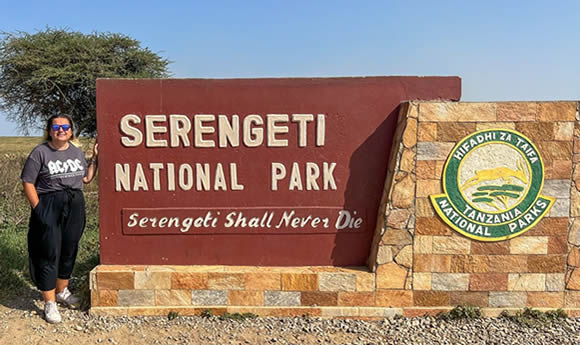
Day 4: Manyara to Serengeti National Park (Central/Seronera)
This is the longest and most spectacular driving day — roughly 4–5 hours covering some of Tanzania’s most dramatic scenery. From Mto wa Mbu, you’ll climb the escarpment and cross the Ngorongoro Conservation Area, passing the crater rim (stop at the viewpoint for photos and a break) before descending onto the plains toward Naabi Hill Gate, the main entrance to Serengeti’s central Seronera area.
The road from Ngorongoro to Naabi Hill is unpaved but generally well-graded; expect dust in the dry season and slower going after rain. Budget extra time here — this isn’t a stretch to rush, both for road conditions and because the plains along the way often deliver early sightings of wildebeest, zebra, and gazelle.
Complete entry formalities at Naabi Hill (bring printed park permits and passports) and continue into Seronera, the ecological heart of Serengeti, known for year-round resident game and a strong predator population — lion, cheetah, and leopard are all regularly seen along the Seronera River valley.
Settle into your camp with time for a late-afternoon game drive before dark.
Drive time: ~4–5 hrs | Overnight: Seronera/Central Serengeti
Day 5: Full Day in Serengeti — Seronera & Beyond
Dedicate this full day to exploring Seronera and its surrounding circuits. Start at dawn — predators are most active in the first two hours of light — and work the river valley tracks where lions favor the rocky kopjes for shade and vantage points.
If your itinerary coincides with the Great Migration (roughly December–March in the southern Serengeti/Ndutu plains, or June–July further north and west), consider adjusting your route slightly to intercept the herds; ask your camp or the ranger post at Naabi Hill for the latest migration positions, since they shift with rainfall.
Otherwise, Seronera’s resident wildlife alone justifies a full day: hippo pools, black-backed jackal, serval cat sightings, and excellent birding (over 500 species recorded park-wide) round out the drives. Return to camp for a second night, allowing an early start the next morning for the transfer to Ngorongoro.
Drive time: minimal (game drives only) | Overnight: Seronera
Day 6: Serengeti to Ngorongoro Crater Rim
Depart Seronera mid-morning, retracing the route back through Naabi Hill Gate and up onto the Ngorongoro Conservation Area highlands. The drive takes about 3–4 hours including a stop at Olduvai Gorge, the site of major early-hominid fossil discoveries and a small but worthwhile museum — a nice change of pace from wildlife-watching.
Continue up to the crater rim, arriving at your lodge or campsite by mid-afternoon. The rim sits at over 2,200m, so expect a noticeably cooler, often misty climate compared to the plains below — pack a warm layer for evenings, especially if you’re doing the 4×4 camping Tanzania route rather than staying in a heated lodge room.
Spend the late afternoon settling in and enjoying the crater-rim views; some lodges (Ngorongoro Serena, Rhino Lodge) offer sunset viewpoints directly over the caldera. Confirm your descent permit and vehicle inspection requirements for the following morning — self-drive vehicles must meet certain specifications to descend into the crater, and a compulsory guide or ranger may need to accompany you (check current NCAA rules with your rental company before travel, as these are periodically updated).
Drive time: ~3–4 hrs | Overnight: Ngorongoro Crater rim
Day 7: Ngorongoro Crater Descent & Return to Arusha
Descend into the crater at first light — the road down opens around 6am, and an early start rewards you with the best light and least traffic congestion inside this compact, wildlife-dense caldera. Ngorongoro Crater is famous for its density of resident wildlife within a roughly 260 sq km floor, including one of the highest concentrations of predators in Africa and a small, closely protected population of black rhino.
Spend 4–5 hours exploring the crater floor, covering the Lerai Forest, the soda lake (Lake Magadi) for flamingos, and the swampy Ngoitokitok springs area, a popular picnic spot. Vehicles must exit the crater by early-to-mid afternoon per NCAA regulations, so plan your final laps accordingly.
Climb back up the rim road and begin the drive back to Arusha, approximately 3–3.5 hours via Karatu and Mto wa Mbu. This gives you time to return your rental vehicle, refuel, and catch an evening flight from Kilimanjaro Airport, or overnight once more in Arusha if your flight is the next morning.
Drive time: ~3–3.5 hrs | Overnight: Arusha or departure
Practical Self-Drive Tanzania Notes
- Vehicle: A proper 4×4 (Land Cruiser or similar) with pop-up roof, high clearance, and two spare tires is non-negotiable, especially for the Serengeti and crater roads — this is the backbone of any reliable self-drive Tanzania setup.
- Fuel: Fill up in Arusha, Karatu, and Mto wa Mbu — fuel is not reliably available inside the parks.
- Permits: Book TANAPA (Tarangire, Manyara, Serengeti) and NCAA (Ngorongoro) permits in advance through a licensed operator or the official portals; gate-side payment options are limited.
- Guides: While self-driving is legal and common, many travelers hire a local driver-guide for the Serengeti/Ngorongoro legs, both for game-spotting expertise and because rental insurance sometimes requires it for crater descents.
- Camping gear: For a proper 4×4 camping Tanzania trip, pack a roof tent or ground tent rated for cool nights, a reliable camp stove, extra water containers, and a good cooler box — public campsites inside the parks are unfenced, so camp discipline around food storage matters.
- Timing: This itinerary works best in the dry season (June–October) for road conditions, though the wet season (November–May) offers lush scenery, newborn wildlife, and lower crowds — just budget extra driving time.
This route covers roughly 500–600km of driving over the week, leaving ample time in each park for genuine game viewing rather than rushing between stops — arguably the biggest advantage of a self-drive Tanzania safari, whether in lodges or a full 4×4 camping Tanzania setup, over a scheduled group tour.